Showing posts with label Japanese Whisky. Show all posts

Tuesday, August 27, 2019


Nikka From The Barrel

Launched in the mid-1980s, Nikka From the Barrel (NFTB) is a “go to” everyday Japanese Whisky for many. While most modern Japanese whiskies clock in between 40-45% alcohol by volume (ABV), NFTB boldly reaches for 51.4%. Apparently, that’s 90 Proof in Ye Olde England, so not as random as it may seem.  (For extra credit, if you want to solve Her Majesty’s Proofage multiplier, consider that Glenfarclas 105 is 60% ABV.)  Lastly, not only is it complex and delicious with over 100 unique whiskies in the blend, NFTB is a bargain AND available…at least, outside the United States.

Limited Edition
3000ml  (2014)
North Americans usually discover NFTB when someone else brings it back from some far-off land.  When that happened for me, I was hooked.  Thereafter, whenever myself or a friend was visiting Europe or Japan, it’s a guarantee that we would be bringing back as many of those 500ml block-shaped bottles as we could.  But that wasn’t enough, so ordering it online and often was the next step down a slippery slope.  By the time I discovered that Nikka had released a whopping 3 Liter Edition in Europe in 2014 to celebrate Nikka’s 80th Anniversary, I HAD to have it! I mean, it comes with its own custom glass valinch, for crying out loud. But the real question was when would this glorious whisky finally be made available in the United States?

At last, in the fall of 2018, the first 750ml bottling of NFTB hit the US for around $65.  Fans snatched it up and it was quickly sold out at the major chains.  Next, it was allocated, which resulted in higher prices.  And then Whisky Advocate Magazine named it their Whisky of the Year to guarantee that it would be impossible to find!  Hopefully Nikka produces enough to meet demand soon. And that hoarders stop hoarding. And that bloggers stop mentioning how tasty and affordable it is.  D'oh!

So why did it take so long for Nikka to accommodate the US market with this product? The first thing that comes to mind is the current scarcity of Japanese-distilled whisky in general. But this is a blend after all, and Nikka’s whisky shortages really only apply to their single malt selections.  Moreover, that would not have even been a factor to consider 5+ years ago.  Additionally, Nikka Coffey Grain has been available for years, so why not the superior NFTB?

I think it comes down to volume and tradition.  Part of NFTB's appeal is that it is a half liter brick of whisky and has always followed that format, saving a few special one-off releases like the aforementioned 3L behemoth.  However, 500ml bottles are not currently acceptable for spirits in these United States, nor has it been since the 1980s. It took a while, but Anchor/Hotaling Imports must have finally convinced Nikka to create a 750ml block bottle for North America.


And finally, much to my (and I'm sure almost everyone's) surprise, 2018 was NOT the first time that Nikka From The Barrel was distributed in the USA. NFTB was actually available back in the late 1980s. The 500ml format was outlawed in the United States in the middle of 1989, but not before Wine of Japan Imports released a few cases.  Who knew??  So, after a 30 Year absence, welcome back, Nikka From The Barrel!  Now get back on our shelves!!


Wednesday, April 24, 2019


A Brief History of Hibiki

1991 Advertisement
1989 Box Art
Suntory introduced their first Hibiki Whisky in April 1989, released to celebrate the 90th Anniversary of the company.  The No Age Statement (NAS) premium blend at 43% Alcohol By Volume (ABV) carried a suggested retail price of ¥10,000.  Designated as “a masterful blend of specially aged whiskies with a mature full-bodied taste” on the front, the back label further elaborates that the contents are a mix of 30 different whiskies.  The unique bottle, with its 24 facets that reflect the hours in the day as well as all the ‘small seasons’ in the year, sported a medallion, a gold cap stopper, all packaged in a luxurious box.   

Originally, I assumed that Hibiki was Suntory’s answer to Johnnie Walker Blue, the worldwide big time premium blended whisky.  But the Blue wasn’t launched until 1992.  Turns out Hibiki was most likely a response to in-country rival Nikka and their Taketsuru Fortune ’80 premium blend.

2000 European Bottle + Box

In the 1990s, Hibiki made its way to the United States retailing for around $50, but appeared to have had little impact, with a similar story in Europe.  The stopper updated from gold cap to a faceted clear stopper, more in line with the bottle design.  In 1994, Hibiki 21 Year debuted, followed by Hibiki 30 Year in 1997.  And around this time, the original Hibiki NAS went from a mix of 30 different elements to 36 unique whiskies in the blend. 

2002 Japanese Label
At the turn of century, all Hibiki expressions transition from being labeled as “masterful blend” to “harmonious blend” – likely to be more in accord with the theme of sound surrounding the name. Hibiki translates to echo, music, sound, reverberation and space.  Also getting updated was the original NAS into an age-stated 17 year old.  In fact, the UPC barcode that had been used since the mid-1990s didn’t even change during this transition.  So, this is where confusion comes into play whether the original Hibiki was a 17-year expression all along.  I don’t believe it was.  I’m sure Suntory would have stated an age from the beginning if it qualified as such.  Not only was this common practice worldwide at the time, but that’s the case for other Suntory releases as well.

The highlight of this period for Hibiki has to be when the 17 Year Old was prominently featured in the motion picture, Lost In Translation.  Filmed in the fall of 2002, there's a frustratingly funny scene with Bill Murray as Bob Harris filming a commercial where he has to deliver a tagline, with intensity.  "For relaxing times, make it Suntory Time." 

A couple new expressions rounded out the decade.  First was the short-lived Non-Chill Filtered 50.5% ABV Hibiki 17, definitely ahead of its time.  In 2009, Hibiki 12 entered the scene and showcased whisky aged in ex-plum wine casks which was unique for the brand. Additionally, this was the decade where Hibki started to win awards in worldwide competitions. Hibiki 30 won multiple awards including Best Blended Whisky from World Whiskies Awards in 2007 and 2008.

Kacho Edition Version 2
The infamous Kacho Fugetsu editions started appearing at Duty Free shops in 2010.  The bottle and box of these Limited Editions of the 12, 17, 21, and 30 Year were uniquely designed to embody the beauty of Japanese nature.  In 2013, a couple Japanese bar-only releases, Deep Harmony and Mellow Harmony, could have been a precursor experiment that lead to the NAS Harmony in 2015 - which was also the same year that saw the discontinuation of the 12 Year expression.  Duty Free shops is also where you can find both the regular and Kacho editions of the Hibiki Harmony Master's Select, which is a slightly different blend than the regular release. 

The oldest Hibiki expression is the 35 Year Old, last released in 2016.  It's super limited and comes in unique ceramic bottles.  The 17 and 21 Year won a bunch of awards during the 2010s as well.  And another bar-only release came out in Japan in 2018, dubbed Blenders Choice.  Sadly, Hibiki 17 production has been suspended, another victim of dwindling aged whiskies in Japan.
2019 marks the 30th Anniversary of the brand -- Happy Birthday Hibiki!

Thursday, January 31, 2019


SUNTORY COMPARISON TASTING

A few years ago, I had a Hakushu 12 that seemed to stand out from prior releases.  The expression had always been enjoyable, but did not really stand out, at least for me. However, this particular bottle was memorable. Had my flavor profile developed that I now appreciated subtleties previously unperceived?  Or was this particular batch just a little more outstanding than prior (and subsequent) releases? 
Unfortunately, this was prior to my discovering bottling codes, so I never recorded the code and wasn't able to successfully hunt for more of that particular batch.  However, it did put the thought into my head:  Did Hakushu 12 or Yamazaki 12 or Hibiki 17 taste differently/better from batch to batch.  What about bottlings from 15-20 years ago...

* YAMAZAKI FLIGHT *
Expression 1
 10 Year Pure Malt 
 

Background: Added to Yamazaki's core range in 1995, this expression, along with the Hakushu 10, were among the first casualties of the dwindling supply of Japanese whisky as both were discontinued in 2012.  Neither expression ever made it to the United States. The Pure Malt designation is really a misnomer - this is definitely a single malt. Click here to read more on what's up with that.  

Stats: ABV=40%. Bottled 1996/97. 750ml Japan Bottling.

Tasting Notes: The opener presented itself as a lighter version of Yamazaki 12, which makes sense since it's younger and at a lower ABV.  What was surprising was the honey notes that I usually associate with Hakushu 12.

Worth Drinking Again?Worth Buying a Pour?Worth Buying a Bottle?
YESYESYES

Expression 2
 12 Year Pure Malt 

Background:  The first Yamazaki Single (Pure) Malt  launched in 1984 to celebrate the distillery's 60th anniversary as a No Age Statement.  The 12 Year succeeded that one in 1986 and has been around ever since.     

Stats: ABV=43%.  Bottled 2001/02.
 750ml Japan Bottling.

Tasting Notes: The nose is nutty, but fairly flat. Definitely lighter and sweeter than current offerings.  Big time confectioners sugar finish.  It seemed likely that this iteration was solely designed for the Japanese palate and that the heavier results from recent years are geared more to a worldwide market.

Worth Drinking Again?Worth Buying a Dram?Worth Buying a Bottle?
YESYESYES

Expression 3
 12 Year Single Malt 

Background: The 12 Year arrived in both the U.S. and Europe in the early 1990s, as did the original Hibiki NAS. Those two expressions appear to be about all that Suntory distributed outside of Japan that decade, aside from the mid-range blends like Suntory Royal.

Stats: ABV=43%. Bottled 2016. 
 750ml US Bottling.

Tasting Notes: That characteristic flat, nutty nose is still present, but the overall impression is a heavier spirit compared to the early 2000s offering.  There's a little more sherry and licorice notes.  Woodier.  Admittedly, I'm very familiar with this flavor profile from recent years - I've consumed a lot of it!  The earlier version just felt like a breath of fresh air.  Even the 10 year seemed to have a more interesting range.  It's all probably just relative.

Worth Drinking Again?Worth Buying a Dram?Worth Buying a Bottle?
YESYESYES

Expression 4
 12 Year Watami President Choice 

 
Background: Watami is a restaurant chain in Japan that has been offering exclusive Suntory whiskies to their customers since at least 2008.  The President Choice and the Founders Choice are both unique variations of Yamazaki 12.  There's a Suntory Blenders Choice as well.

Stats: ABV=43%. Bottled 2013/14. 
 660ml Japan Bottling.

Tasting Notes: The big Sherry nose sets this one apart at the onset from the regular 12, and evolves into soft and flowery. The taste, while not as heavy, has the expected woodiness but adds a crazy hazelnut finish that lingers.

Worth Drinking Again?Worth Buying a Dram?Worth Buying a Bottle?
YESYESYES

* HIBIKI FLIGHT *
Expression 1
 17 Year (~2002) 
 

Background: Hibiki was introduced as Suntory's first premium blend in 1989, ninety years after the company was founded.    That initial No Age Statement expression evolved into the 17 Year by 2001.

Stats: ABV=43%. Bottled 2002/03.  750ml Japan Bottling. 

Tasting Notes: Not much of a nose but the taste lives up to their "harmonious blend" tagline: subtle complexities with a light, pleasant mouth feel and mizunara notes on the finish.  Mizunara is Japanese Oak - whisky barrels made from that wood are rare and expensive.  What mizunara oak transfers to the spirit is hard to describe, but when you taste this, or the 21, you immediately recognize it!  

Worth Drinking Again?Worth Buying a Pour?Worth Buying a Bottle?
YESYESNO

Expression 2
 17 Year (2017) 

Background:  
Along with Hakushu 12, Hibiki 17 was recently suspended from regular production.  As if bottles weren't hard enough to find already!  With news like that, it's easy to jump to conclusions that they've been discontinued entirely.  But it's entirely possible that production has only slowed and/or that distribution will be limited.  Now, if they report the same thing for Hibiik 21 in a couple years, then it's really time to panic!

Stats: ABV = 43%.  Bottled 2017.
 750ml US Bottling.

Tasting Notes: Similar complex range as the prior bottle, with a more floral nose, spicer taste and additional Sherry notes on the finish.  I actually prefer this  to the older one.

Worth Drinking Again?Worth Buying a Dram?Worth Buying a Bottle?
YESYESNO

Expression 3
 12 Year 

Background: Introduced in 2009 and discontinued in 2015.  Unlike any other Hibiki expression, the 12 contains spirit aged in plum wine casks.  Note that the 12 does not become the 17 which does not become the 21.  They are all unique animals.

Stats: ABV = 43%. Bottled 2014. 
 750ml US Bottling. 

Tasting Notes: Younger spirit results in sharper flavors to create the illusion of a higher ABV, but, of course, it's the same 43% as the others.  Overall, there appears to be less sherry and possibly no mizunara in the blend, so the plum wine notes of chocolate ovaltine tend to stand out amongst this particular harmonious blend. 

Worth Drinking Again?Worth Buying a Dram?Worth Buying a Bottle?
YESYESYES

* HAKUSHU FLIGHT *
Expression 1
 12 Year Pure Malt 

Background: The first release from Hakushu was the 12 Year Single (Pure) Malt, debuting in 1994, just over 20 years after that distillery was constructed in 1973.  

Stats: ABV=43%. Bottled 1997/98. 
 750ml Japan Bottling.

Tasting Notes: Hakushu has a reputation of being on the peaty side.  While that's definitely true compared to Yamazaki, it's nowhere near your average Islay peat.  However, this late 90s version hits with medium peat right away, drifts toward spicy cinnamon honey and ends with a little smokey finish.  Totally different than recent batches, but equally as good, if not better.  I need to compare this with Laphroaig 15 or 18 at some point.

Worth Drinking Again?Worth Buying a Dram?Worth Buying a Bottle?
YESYESYES

Expression 2
 12 Year Single Malt 

Background: Prior to 2018, Hakushu 12 has been sold with an outer box in all territories except the United States.  But last year, BeamSuntory finally included an outer box with their US bottlings.  Then, as previously mentioned, they promptly suspended the expression.  Oddly enough, this same "strategic" scenario was utilized with Hibiki 12 in 2015.  Weird.

Stats: ABV=43%. Bottled 2017
.  750ml Japan Bottling. 

Tasting Notes: Not as big of a range as I was hoping for.  Bolder finish than the 90s bottling.   I so wish i would have written down the bottle code from the magical batch of a few years prior.  2015, maybe?  Grr. 

Worth Drinking Again?Worth Buying a Dram?Worth Buying a Bottle?
YESYESYES

Expression 3
 1996 Single Cask 12 Year  

Background: Yamazaki and Hakushu both provided two single cask releases each to celebrate the 150th Anniversary of Yokohama Port.  This Hakushu is the first release from 2008 and was limited to 312 bottles.  

Stats: Ex-Red Wine Cask. ABV=63%. Bottled 2008.
 #78/312. 700ml Japan Bottling.

Tasting Notes: What a nose!  Could it be Bordeaux?  Huge range: flowery sweet, nutty goodness, and chocolate!  Boom goes the dynamite!!  With water, flavors leveled out as expected and the spirit felt more oily.  But with or without, this one is a winner!  More cask strength Hakushu, please.
Worth Drinking Again?Worth Buying a Dram?Worth Buying a Bottle?
YESYESYES

[Tasting conducted with the Sneaky Trips Tasting Group which consists of Whisk(e)y Enthusiasts ranging from Beginner to Advanced.  Tastings are held monthly and are usually 8 Expressions based on a particular theme.]

Wednesday, November 21, 2018

Bottling Dates for Yamazaki, Hibiki, Hakushu

Part 3


Previously in Part 1 and Part 2, bottle codes and packaging changes offered clues as to when a particular Yamazaki, Hibiki, or Hakushu was bottled.  Bottle codes were great, but they only went back to 2006.  For older bottles, packaging variances narrowed down the bottling date a bit, but there could still be a wide range in some cases.  So, how to pare it down further?

Glass Date
Old Forester
AB 217470
86 Proof
Bottom Glass of Old Forester
Top Row = L-1014
Bottom Row = S 
Φ 88
What about investigating the raised lettering on the bottom of the bottles?  That's a proven method for approximating the bottling dates for older bourbons.  I have a dusty Old Forester that has “88” among other information on the bottom of the glass.  Often, this translates into the bottle mold being made in 1988, but not necessarily the year it was filled with spirit.  However… it’s usually pretty close to that year.  Definitely not 1987 or prior, the OF could possibly be from 1988 or 1989.  You would then have to review the labels for corroborating evidence that would place it around that time.

Unfortunately, on Yamazaki/Hibiki/Hakushu bottles, there are no consistent two digit numbers  similar to the bourbon example above.  What can be found, and this goes back to the 1980s at least, are words, letters, and numbers.  So, let’s explore that.

The words will spell out SUNTORY (LTD) and JAPAN, and, depending on the expression, LIQUOR BOTTLE. (U.S. Hibiki bottles will most likely have 750ML on the bottom glass as well.)  Pretty straight forward – no insight here.

2018 Hakushu 12
First Time Released
With Box in U.S.
Two “rows” of alphanumeric code are present.  The top row format consists of a
one or two-digit number, followed by some blank space, followed by a single letter or a letter plus an additional letter/number. A few examples of top row strings are “4     YS”, “11     T3”, and “2     Y”.  The second set of characters must point to bottle type as YS can be found on the latest U.S. Hakushu 12s, while T3 shows up on various Hibiki bottles. The preceding number(s) can’t have anything to do with the bottling date, however, as they will vary on bottles that are definitely from the same year.  One of the recent Hakushu 12s has top row of  “4     YS” while another one has “14     YS”.

Bottom of 2018 Hakushu 12
Top Row = 4   YS
Bottom Row = 7 - III
So, what about the second row?  The format is always a single digit number, usually followed by a dash, then followed by one to four vertical lines.  Staying with the aforementioned 2018 Hakushu 12s, the bottom string on all of them is “7 – III”.  Now that's interesting!

Let’s investigate some other bottles and that bottom row, starting with expressions that have already established bottling dates via the label, regardless of the bottle code.  Yamazaki put out an annual Limited Edition release between 2014-2017. The bottom string on my 2017 bottling is “6 – IIII”.  The bottom row of Yamazaki Bourbon Barrel 2013 reads “3 – III”.

Transferring this and other available data to the table below, can you recognize a pattern emerging?

EXPRESSION GLASS
BOTTOM ROW
BOTTLING
CODE
BOTTLING
YEAR
Hakushu 12 7 - III LK8ANN 2018
Hakushu 12 7 - III LK8AMC 2018
Yamazaki LE 2017 6 - IIII LX7DOK 2017
Yamazaki 18 3 - IIII W4EJE 2014
Yamazaki 18 3 - IIII S3LJW 2013
Yamazaki Bourbon 2013 3 - III X3OJJ 2013
Hibiki 12 2 - II U2LOT 2012
Hakushu 1994 6 - III D6JOA 2006

In Part 1, the Bottling Code pattern revealed that the single digit before the 3 letters at the end (or the middle in some cases) represents the last digit in the bottling year.  On the bottom row of the glass, the single digit on the left either matches that "key number" on the bottling code or equals the key number minus one.  Every time.  I've looked at over a hundred bottles with bottling codes and this pattern is consistent.  If you've got one that doesn't conform, I'd like to see it!

Now let's apply the single digit theory to the glass.  It seems a reasonable conclusion that the "key number" on the left of the bottom row on the glass is the last digit of the year in which the bottle was manufactured.  And I believe it is fair to then assume that the bottle was either filled that same year or the following year.   And that's it, mystery solved!

The next step is to review some data from pre-2006 bottles, swapping out Bottling Code for significant markers from the label or bottle that support the bottling year estimation.

EXPRESSIONGLASS
BOTTOM ROW
MARKERBOTTLING
YEAR
Hibiki 172 - IIIIHibiki Crest2002/2003
Yamazaki 121 - IIPure Malt2001/2002*
Hibiki (Original)8 - IIIIHibiki Crest1998/1999
Hakushu 127 - IIIIPure Malt1997/1998
Hibiki (Original)7 - IHibiki Crest1997/1998
Yamazaki 106 - IIPure Malt1996/1997
Hibiki (Original)5 - IIIGold Stopper1995/1996
Yamazaki 185 - IIIPure Malt1995/1996

1995 Yamazaki 18
Bottom Row 5 - II
The Hibiki 17 is from 2002/2003 and not 2012/2013 because it has a Hibiki Crest on the label. And we've established that Hibiki 17 did not appear until 2001, so it's not from 1992/93.  But it's not always so cut and dry.  Any Yamazaki 12 with a 1, 2, or 3 key number on the glass can be problematic.  Both 1991, 1992, 1993 and 2001, 2002, 2003 bottlings would have both the Hibiki Crest and Pure Malt designation.  Yamazaki 18s would have a similar challenge for those year ranges as well if not for the bottles being numbered in Japan during that span.  Lower numbered labels would be the early 1990s.  So, deeper diving into label variation is necessary for those cases, but for the most part, the code has been cracked!

Don't want to dive into too much minutiae - the important thing is that you should now be able to answer the question posed in Part 1 and approximate the bottling date of that original Hibiki NAS that you've been wondering about!  Does your bottle have a key number of "0" on the bottom glass and does it have the Lion Crest?  Then you've got a 1990/91 bottling.  If it has the same key number but a Hibiki Crest instead, then you're looking at a 2000/01 bottling.

Monday, October 29, 2018


NIKKA DISTILLERY EXCLUSIVES

For this months's tasting, we sampled almost all of the current Distillery Exclusives from both Yoichi and Miyagikyo.

* FLIGHT ONE *
Expression 1
 Miyagikyo Sherry Cask 2015 
 

The Miyagikyo Sherry
Cask 2015 was
the odds on favorite
to be best in show -
and it was!
Background: Okay, not a distillery exclusive, but an extremely limited special edition. (The Yoichi Heavily Peated came out at the same time.)  This was released right around the time that Yamazaki Sherry Cask 2013 won Jim Murray's Whisky of the Year and set off the current Japanese whisky craze.  

Stats: Limited to 3000 Bottles.  Aged in Spanish Sherry Casks.  ABV = 48%

Tasting Notes: With the high ABV of all the whiskies we were drinking today, it was prudent to have a warm up to get the taste buds acclimated.  Our "opener" was the current Miyagikyo Single Malt NAS @ 45% ABV.  And it helped immensely.  I've had the excellent Sherry Cask 2015 before, but this time, it was transcendent.  Perhaps a little air in the bottle helped? Incredibly well balanced and complex.  This beauty is definitely not a one note sherry bomb like the Yamazaki Sherry Cask 2016.  Exceptional.

Worth Drinking Again?Worth Buying a Pour?Worth Buying a Bottle?
YESYESYES

Expression 2
 Miyagikyo Sherry + Sweet 

Background:  
When this line of Distillery Exclusives was originally rolled out, they were all 12 Year Age Statements.  A few years back, new packaging was introduced as well as converting to No Age Statement along with all of Nikka's single malts.

Stats: ABV = 55%.  Bottled 2016.
 

Tasting Notes: Prefer the nose on this one - definitely punchier as expected with the higher ABV.  But the taste isn't as complex as the 2015 - more of a one note sherry bomb, plus a short finish.  Still, it's Miyagikyo Sherry - I wouldn't slam the door in its face should it come calling in the middle of the night.

Worth Drinking Again?Worth Buying a Dram?Worth Buying a Bottle?
YESYESYES

Expression 3
 Yoichi Sherry + Sweet 

Background: All of the Distillery Exclusives have unique names for each distillery - except this one.  Sherry + Sweet expressions exist at both Miyagikyo and Yoichi.  You really have to pay attention as to which is which since the design is so similar.

Stats: ABV = 55%. Bottled 2017. 
 

Tasting Notes: Nose leans toward expected Yoichi coastal, peaty notes.  A meatier, buttery taste as well compared to its counterpart, along with salty and light peat notes.  Finish is more on the chocolate-y side.  Nice range overall.  This one should be called Sherry + Salty + Sweet.

Worth Drinking Again?Worth Buying a Dram?Worth Buying a Bottle?
YESYESYES

Expression 4
 Yoichi 2000's 

 
Background: Comprised of single malt whisky distilled anywhere between 2000 and 2009.  Miyagikyo also has a 2000's expression, but that was one of two Distillery Exclusives that were not part of this tasting.  (The other being Nikka Coffey Grain Woody + Mellow.) Similar 1980's and 1990's expressions exist as well, but those are long gone from the Distillery Gift Shops.

Stats: ABV = 57%. Bottled 2017. 
 

Tasting Notes: Spicy nose.  Not as peaty as expected.  Caramel dominates taste and finish.  Adding some water produced a better range, spreading out the dense flavors, and making it more enjoyable.

Worth Drinking Again?Worth Buying a Dram?Worth Buying a Bottle?
YESYESNO

* FLIGHT TWO *
Expression 1
 Miyagikyo Fruity + Rich 

Background: Nikka Distillery Exclusives are only available at their respective gift shops.  Yoichi expressions only at Yoichi.  Same for Miyagikyo.  The aforementioned Nikka Coffey Malt Woody + Mellow is the only exception - it can be purchased at either. So you'd have to go to both distilleries to get them all.  No easy task.  All are bottled at 180ml and 500ml.

Stats: ABV = 55%. Bottled 2016 
 

Tasting Notes: Aptly named with its big fruity nose.  Taste is apricot malty finished in powder sugar on a glazed donut.  Not a huge range, but very nice indeed.

Worth Drinking Again?Worth Buying a Dram?Worth Buying a Bottle?
YESYESNO

Expression 2
 Yoichi Woody + Vanillic 

Background: Yoichi was the first Nikka distillery, founded in 1934 by Masataka Taketsuru.  Prior to that, he was one of the two men behind the first Japanese Whisky Distillery, Yamazaki.

Stats: ABV = 55 %. Bottled 2017
 

Tasting Notes: Hello Japanese Bourbon! Could each of these "x + y" expressions just be the 3 components for their respective core range of distillery single malts? Sherry, Bourbon, and some sort of Puncheon or Hogshead?  This one would be the Bourbon Barrel, if you couldn't tell. Big time Bourbon nose and that smooth, sweet taste.

Worth Drinking Again?Worth Buying a Dram?Worth Buying a Bottle?
YESYESNO

Expression 3
 Miyagikyo Malty + Soft  

Background: While Suntory can claim the first single malt distillery in Japan, Nikka can boast they had their second before their rival did. Miyagikyo, built in 1969, pre-dates Suntory's second distillery, Hakushu, by 4 years.  The whiskies of Yoichi tend to compare to Scottish Coastal Highlands, or even Islay, while Miyagikyo's distillate is similar to those of Central Highlands and Speyside.

Stats: ABV = 55%. Bottled 2016.
 

Tasting Notes: Big time marshmallow nose at first, evolving into fruit notes.  Tastes like salty malt balls, i.e. Whoppers, with an interesting pear guava finish.

Worth Drinking Again?Worth Buying a Dram?Worth Buying a Bottle?
YESYESNO

Expression 4
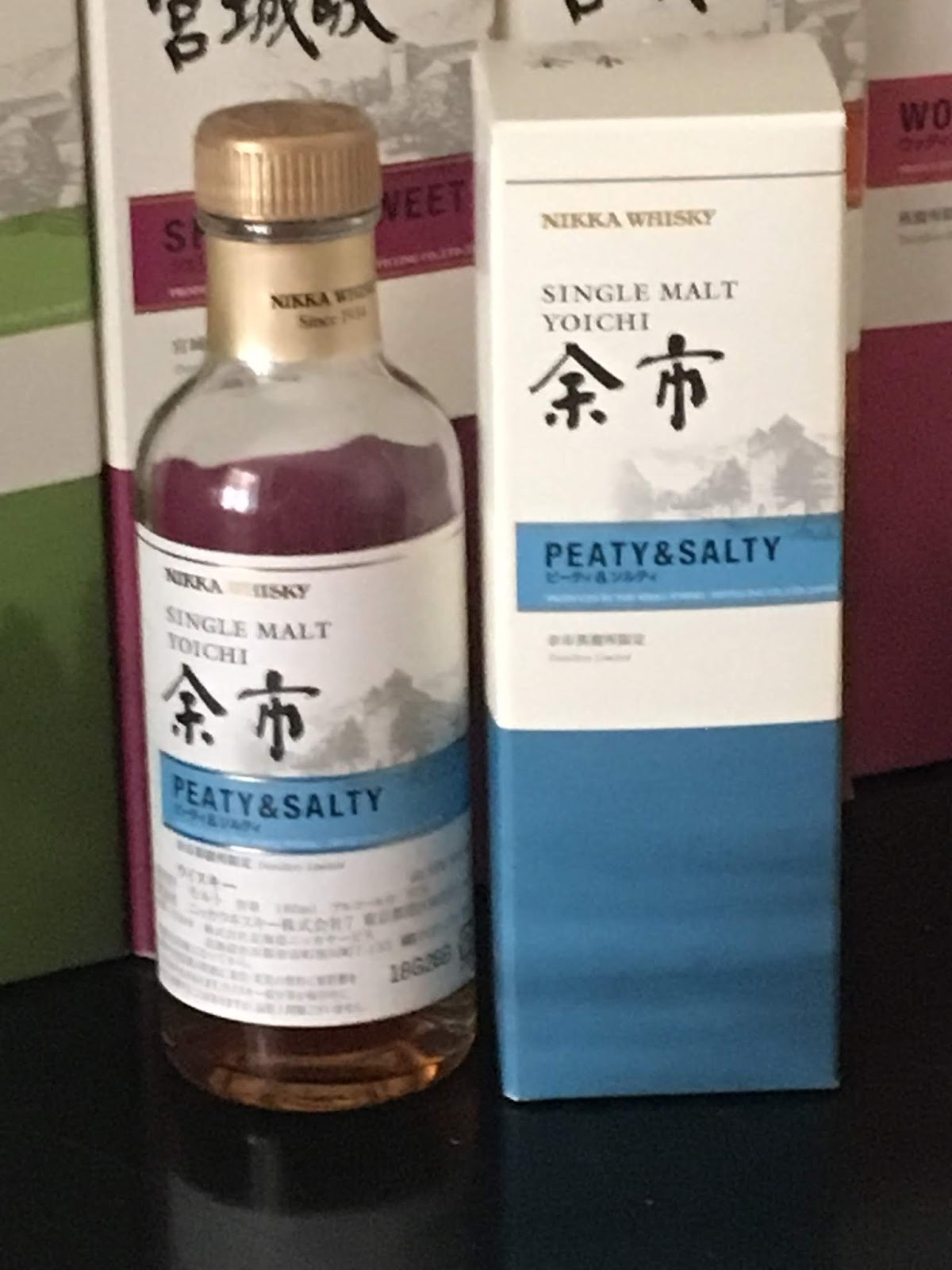
 Yoichi Peaty + Salty 

Background: Nikka was the first Japanese producer to win a major international award for its whisky.  In 2001, a Yoichi 10 Year Single Cask won Whisky Magazine's Best of the Best category.  

Stats: ABV = 55%. Bottled 2017.
 

Tasting Notes: Medium peat on the nose.  Taste is Peaty & Salty as described - big time!  Briny, with a soft, salty + malty finish.  Might be the best peated Japanese whisky that I've experienced. Recommend going back and forth with this and one of the Sherry expressions.  Outstanding!

Worth Drinking Again?Worth Buying a Dram?Worth Buying a Bottle?
YESYESYES

[Tasting conducted with the Sneaky Trips Tasting Group which consists of Whisk(e)y Enthusiasts ranging from Beginner to Advanced.  Tastings are held monthly and are usually 8 Expressions based on a particular theme.]

Tuesday, October 23, 2018

Bottling Dates for Yamazaki, Hibiki, Hakushu

Part 2


In Part 1, general bottle codes were discussed as well as specifics on some distilleries, including Suntory.  These bottle codes are batch numbers that can reveal what year a whisky was bottled. Suntory has only printed/etched codes on their bottles of Yamazaki, Hibiki, and Hakushu since approximately 2006.  So, what about dating bottles before then?

Let’s start with the introduction of the core expressions, charting from when the first Suntory Single Malt was released in 1984 from Yamazaki. 

EXPRESSION AGE YEARS AVAILABLE
Yamazaki NAS 1984 - 1986
Yamazaki 12 1986 - Present
Hibiki NAS 1989 - 2000
Yamazaki 18 1992 - Present
Hibiki 21 1994 - Present
Hakushu 12 1994 - Present
Yamazaki 10 1995 - 2012
Hibiki 30 1997 - Present
Yamazaki 25 1998 - Present
Hakushu 10 1998 - 2012
Hibiki 17 2000 - 2018
Hakushu 18 2006 - Present
Hakushu 25 2008 - Present
Hibiki 12 2009 - 2015
Yamazaki NAS* 2012 - Present
Hakushu NAS* 2012 - Present
Hibiki Harmony NAS 2015 - Present
(*Distiller's Reserve)

Most of the information above comes from the Yamazaki Distillery Museum as well as the Timeline on Suntory's website.  We'll have to see if Suntory's May 2018 announcement that Hakushu 12 and Hibiki 17 would be suspended that year until supply catches up with demand holds true.  I suspect those expressions will be out of production, with some stock being held back and distributed sporadically in subsequent years.  This strategy occurred previously when Hibiki 12 was discontinued in 2015, but continued to show up here and there over the next couple years, at least in the United States.  The only difference being that Hibiki 12 has not, and likely will not, return.  [UPDATE: Hakushu 12 officially back in core line-up as of 2021.]

Speaking of Hibiki 17, there are those out there that believe that the original Hibiki No Age Statement (NAS) from 1989 should actually be considered Hibiki 17 and not NAS.  I'll dive into that mess another time.  But for purposes here, my research shows that the first time a 17 Year age statement appeared on a Hibiki bottle was in 2000/2001.  At any rate, in order to break down bottling dates even further, we need to look at the label for certain markers and design changes.

Markers
Tax Classification (1984-1989)
Katakana characters at the
bottom left translate to
"Whisky Special Class"
 

Isolating the two 
Katakana characters 
referring to tax code
From the seventies until the end of eighties, there was a requirement for whisky bottles sold in Japan to categorize their contents as either First Class, Second Class, or Special Class.  Essentially, this classification was based on the alcohol content and determined the amount of tax that would be charged.  In the pic to the right, the first 5 Katakana characters are probably familiar – they translate to “whisky” - while the last two designate the Tax Class.  If your bottle has those last two characters, then it was bottled mid-1989 or prior.  If your bottle just has the “whisky” characters and nothing else, then it was bottled after that.  This marker only applies to the first 3 expressions on the chart above.

Corporate Logo: Lion Crest (1984-1991) vs. Hibiki Crest (1991-2004) 
Lion Crest circa 1989
Hibiki Crest 1991-2004

Suntory’s Lion Crest logo evolved over many years until it appeared as shown on the left in the late 1980s.  The Lion Crest is most useful in determining a first edition Hibiki Whisky.
In 1991, a new corporate identity was adopted, the Hibiki Crest (sometimes referred to as the Flower Crest, among others). And it can be found on bottles until at least 2004. Oddly enough, the Hibiki Crest is not directly related to Hibiki Blended Whisky.  In fact, the logo actually pre-dates Hibiki Whisky by 3 years.  For more on the origins of the Hibiki Crest, click through to this blog.

Malt Designation: Pure Malt (1984-2003) vs. Single Malt (2004-on)
Hakushu Pure Malt 12
(Japan Bottling 1997)
Hakushu Single Malt 12
(US Bottling 2018)

Suntory labeled their single malts from Yamazaki and Hakushu as “Pure Malts” from 1984-2003.  As far as the Scotch Whisky Association (SWA) is concerned, a Pure Malt equates to a vatting of single malts from more than one distillery.  Japan has no such regulatory association governing their whisky. And while true Japanese whisky has always sought to emulate the traditional Scotch-making process, they obviously do not have to follow any SWA definitions.

So why didn’t they designate their single malts for what they were?  Marketing and tradition, I suspect.  “Purity” is just a better selling point in Japan.  I’m guessing the reason they changed to labeling them as Single Malts was to finally get more in line with the rest of the world, to improve international sales, and so their whisky could be entered into the correct category in competitions.  Also note that circa 2003, there was a transition period where Yamazaki and Hakushu were classified as both Pure Malt and Single Malt on the same label!
Hakushu Pure/Single Malt 12
(Japanese Bottling 2003)

Bottle Volume: 760ml vs. 750ml vs. 700ml

Japan has utilized a variety of unusual bottle capacities over the years for their core expressions, including 600, 660, 720, 760ml, among others.  When Yamazaki was first introduced in 1984, the bottle contained 760 milliliters and appears to stay that way until approximately 1988, when the standard was updated to 750ml.  I assume the change was implemented so Suntory could export to the US and EU standards.

In 1990, the EU determined their standard bottling would shift from 750ml to 700ml. However, this appears to not have been implemented until 1992. Many assume that Japanese bottlers adjusted at the same time, but that is not the case. (And why would they?  They're not part of the EU.)  This became immediately apparent when I looked at my 750ml Yamazaki Pure Malt 10, a product that didn’t exist until 1995.  At first glance, it appears that Japan switched to primarily 700ml around 1998 with the introduction of Yamazaki 25.

Or did they? I’ve only recently discovered evidence that both 700ml and 750ml bottlings of the same expression existed in Japan in the late 90s to possibly the early-2000s.  Same exact expressions with unique UPC barcodes and different volumes – talk about confusing.  Still researching this head scratcher.  So, unfortunately, there is no definitive marker point for volume change from 750 to 700.

Now, with the information above, we should be able to narrow down some bottling dates within a range of years.  Take the Hakushu 12 Pure Malt above.  That expression was first introduced in 1994.  The Pure Malt designation lasted until 2003. (While the Hibiki logo appears on the bottle, that information is superseded by the Pure Malt information.) But that's still a pretty big range, 1994-2003. It IS 750ml, which leads me to believe that it is a 90s bottling - but, that marker is a little murky as I mentioned.  So how did I confidently claim in the caption that the bottle in question was from 1997?  For that answer, we'll have to scrape the bottom the bottle in Part 3.